
How Ginseng, Polygonum multiflorum, and Ginger Awaken Dormant Follicles with Nature’s Power
Opening: The Hidden Injuries We Too Easily Ignore
Your fingers sweep across the pillowcase in the early morning light. A few strands of hair cling to your fingertips in the shower. You gaze into the mirror, scrutinizing a receding hairline that seems to move farther back each day. The beginning of hair loss often starts with such small, unsettling discoveries.
That moment of inner tremor can happen at any age, to anyone. Data from the National Skin Centre in Singapore shows that about one‑third of adult men suffer from hair loss, while among postmenopausal women the proportion reaches as high as 50 percent. Yet this is only the tip of the iceberg. When people think hair loss is merely an annoying inconvenience, recent research has uncovered a deeper truth: losing hair first harms not your looks, but your inner peace.
01|Silent Suffering: How Hair Loss Wounds the Mind – A Scientific View
When “Visible” Hurts More Than “Invisible”
Dermatologists are often asked a brutal question: “With all our scientific advances, why isn’t there a one‑size‑fits‑all solution for hair loss?” The answer lies in the fact that the hair follicle is called “the smallest but most complex mini‑organ of the human body,” and its intricate workings remain one of biology’s greatest challenges.
Even more complex than the follicle is the human heart.
In 2025, King’s College London conducted the largest study of its kind, published in a leading international dermatology journal. After surveying nearly 600 adults with alopecia areata, the researchers found: more than 80% of patients with hair loss experience anxiety and depressive symptoms; over half feel embarrassed by their condition; and more than one‑third report that the disease creates concrete obstacles in daily life, including work, study, family relationships, and leisure activities.
The study reached a thought‑provoking conclusion: the core factor driving depression in hair‑loss patients is not the severity of the condition itself, but the accompanying “sense of stigma.” In other words, what torments patients is often not pain or itching, but society’s negative perception of hair loss and the patient’s own rejection of their appearance.
This is no isolated finding. Another study included in a leading psychiatric journal revealed equally striking numbers: 46% of patients with androgenetic alopecia show depressive symptoms (ranging from moderate to mild), while 11.6% and 12% respectively suffer from body image distress and low self‑esteem.
Roots of Psychological Wounds: An Overlooked Issue of Self‑Identity
The psychological impact of hair loss is far more complex than it appears on the surface. For many people, hair density and hairline shape are not merely physical traits; they are integral parts of self‑identity. Especially in today’s fast‑paced, high‑stress world, thick hair often represents vitality and robust energy. When these begin to slip away, a deep‑seated sense of panic quietly grows.
Reviews of the literature indicate a bidirectional pathway between hair loss and mental health: on one hand, psychological stress can trigger or worsen all types of hair loss; on the other, the very process of losing hair amplifies anxiety and depression in affected individuals.
You might ask, why does hair loss evoke such a strong emotional response? The answer, according to Psychodermatology, is that hair is one of the few features we can actively control and display, deeply tied to our personal image. When this feature is forced to exit the stage, the feeling that “I am no longer the person I want to be” generates a powerful sense of self‑alienation.
An old friend once confided hesitantly: “I don’t dare to proactively meet friends anymore, because every time we meet they unconsciously glance at my hair… I know it’s probably just a casual look, but I like going out less and less.”
This perhaps explains why hair loss, though not life‑threatening, leaves such a deep wound – especially for young and middle‑aged people, for whom the psychological scar is so hard to heal.
02|Hope Behind the Face: The Era of Plant‑Based Hair Regrowth at the Scientific Forefront
Under this widespread and profound psychological burden, hundreds of millions of people worldwide urgently seek a reliable, safe solution for hair care – one that does not trade health for results, but restores confidence.
The global market size confirms this urgent need. Data shows that in 2025 the global natural hair care product market reached US
11.63billion∗∗andisprojectedtogrowto∗∗US12.44 billion by 2026, with a compound annual growth rate of 7%. Meanwhile, the global anti‑hair‑loss product market is expected to grow from US
Behind these rising numbers hide countless people’s anxiety, trial, and hope.
Notably, “plant‑based” has become the fastest‑growing segment. More and more people are turning away from an over‑reliance on chemical formulations and embracing the wisdom of nature, tested over thousands of years. This is not a simple return to tradition, but a re‑evaluation of ancient methods using the most rigorous modern science.
03|Every Herb Has Its Heart: The Hair‑Growth Secrets of Three Core Botanicals
🌿 Ginseng – The “Activator” That Wakes Up Follicles
In traditional Eastern pharmacology, ginseng is hailed as the “foremost qi tonic.” Surprisingly, this title has been validated by modern science in the field of hair care.
Earlier this year (2026), a systematic study involving 577 Chinese herbs and 714 formulas from the TCM prescription database revealed the deep patterns behind TCM‑based hair loss treatment – ginseng (Panax ginseng), together with Polygonum multiflorum and ginger, is confirmed as a “core Chinese herb” for treating hair loss.
This is no coincidence. Modern pharmacology shows that the most important active group in ginseng – ginsenosides – works on the hair follicle at multiple levels:
First, ginsenosides Rb1 and Rd can effectively induce the expression of the p63 transcription factor in follicular keratinocytes, promoting their proliferation and differentiation, thereby paving the way for hair growth. More importantly, low concentrations of ginseng extract have shown clear promotion of human scalp hair follicle growth in vitro. But there is a crucial caveat: scientific data also show that too high a concentration of ginsenosides can actually inhibit hair growth.
This is why Herbotany always adheres to precise, balanced formulations in product development – not simply piling on high concentrations, but pursuing the optimal harmony.
Furthermore, recent studies have revealed unique advantages of rare ginsenosides for hair care. Research has confirmed that a dissolvable microneedle delivery system for ginsenoside Rg3 achieves effects comparable to the standard drug minoxidil in animal models of telogen effluvium and testosterone‑induced androgenetic alopecia – and the quality of newly grown hair is actually superior. Transcriptome sequencing shows that ginsenoside Rg3 works by activating the Wnt/β‑catenin core signalling pathway for hair growth, producing significant hair‑regenerating effects.
🌿 Polygonum multiflorum – The Quiet Night Healer
Polygonum multiflorum (He Shou Wu) is both mysterious and familiar to many. The most exciting scientific research on this traditional herb over the past five years has revealed startling modern significance.
Previously, the hair‑growth effects of Polygonum multiflorum were attributed to the antioxidant and anti‑inflammatory activities of small molecular compounds such as anthraquinones and stilbene glycosides. However, a breakthrough study by Peking University scientists published in a leading international pharmacology journal in late 2025 completely rewrote this understanding.
Surprisingly, what the researchers first discovered from Polygonum multiflorum was not some new small molecule, but a class of natural structures far finer than a strand of hair – plant exosome‑like nanoparticles. These tiny structures, only 30 to 120 nanometres in diameter, seem to come from another world but have extraordinary functions: each gram of raw Polygonum multiflorum yields more than 2.2 billion of these natural carriers.
Using fluorescent labelling, the team tracked how these nanoparticles precisely enter human hair follicle cells. In co‑culture systems, these tiny vesicles were efficiently taken up by dermal papilla cells – they can cross the natural species barrier between plants and animals and directly “talk” with human cells.
These particles carry plant‑derived microRNA cargo. Two of the most abundant plant miRNAs – aof‑miR168a and osa‑miR164a – were found to precisely recognise and target the human androgen receptor gene, reducing its expression by up to 23.2%.
This discovery is crucial because overactivity of the androgen receptor in follicle cells is one of the core pathological drivers of androgenetic alopecia (the most common “hereditary hair loss”). Thus, when these plant miRNAs from Polygonum multiflorum enter the human body, they act like a precision key, locking onto the central “switch” of hair loss.
Returning to tradition: why has Polygonum multiflorum been regarded as a hair‑care sacred herb? A study published in World Chinese Medicine provided further experimental evidence showing that the traditional processed form (known as “Wen He Shou Wu”) treats androgenetic alopecia in mice by activating the Wnt/β‑catenin signalling pathway.
Additionally, Polygonum multiflorum helps suppress dihydrotestosterone (DHT, the male hormone that shrinks follicles), protects follicle cells from premature apoptosis, and improves local blood supply to the scalp, helping follicles receive more nutrients.
Is Polygonum multiflorum safe? It must be stated objectively: topical use is relatively safe, but oral use carries a well‑known risk of liver toxicity. All Herbotany products are developed with scientifically extracted, safe‑for‑topical‑use ingredients and never involve oral administration or recommendations, perfectly combining ancient wisdom with modern safety standards.
🌿 Ginger – The Pioneer That Opens Pathways
Ginger has a mixed reputation in hair care, for somewhat complex reasons.
On the one hand, some people rub raw ginger on the scalp and find minimal results. Recent medical summaries warn that “6‑gingerol may inhibit the growth of dermal papilla cells and even induce apoptosis”; continuous use for two to three months can worsen hair loss.
At first glance, this would seem to exclude ginger from hair‑growth formulas. Yet academic research offers a more nuanced view.
Earlier studies on cyclophosphamide‑induced alopecia areata in mice showed that ginger extract significantly promoted hair and follicle growth and had the strongest effect on raising skin temperature. Improving local microcirculation in the bald area was identified as a key mechanism for treating alopecia areata.
This suggests something important: ginger plays a very special role in a formula. Rather than being the “main force,” it acts more like a “pathway opener” – by stimulating the skin and opening up the follicular channels, it helps the active ingredients from core herbs like ginseng and Polygonum multiflorum be absorbed more effectively, enhancing the overall penetration.
In Herbotany’s scientific compounding, ginger is used according to the same principle: precise quantitative and qualitative analysis keeps ginger content in the optimal range of “positive safety and no cell inhibition,” positioning it as a synergistic enhancer, not the lead actor.
04|Nature’s Wisdom: The Scientific Compounding Philosophy of Herbotany
Research has shown that while a single botanical extract can be beneficial, it is rarely sufficient to deal with the complex, multifactorial nature of hair loss. The core characteristic of Chinese herbal medicine for hair loss is multi‑target, multi‑pathway regulation, which is fundamentally different from the single‑mechanism logic of modern synthetic drugs.
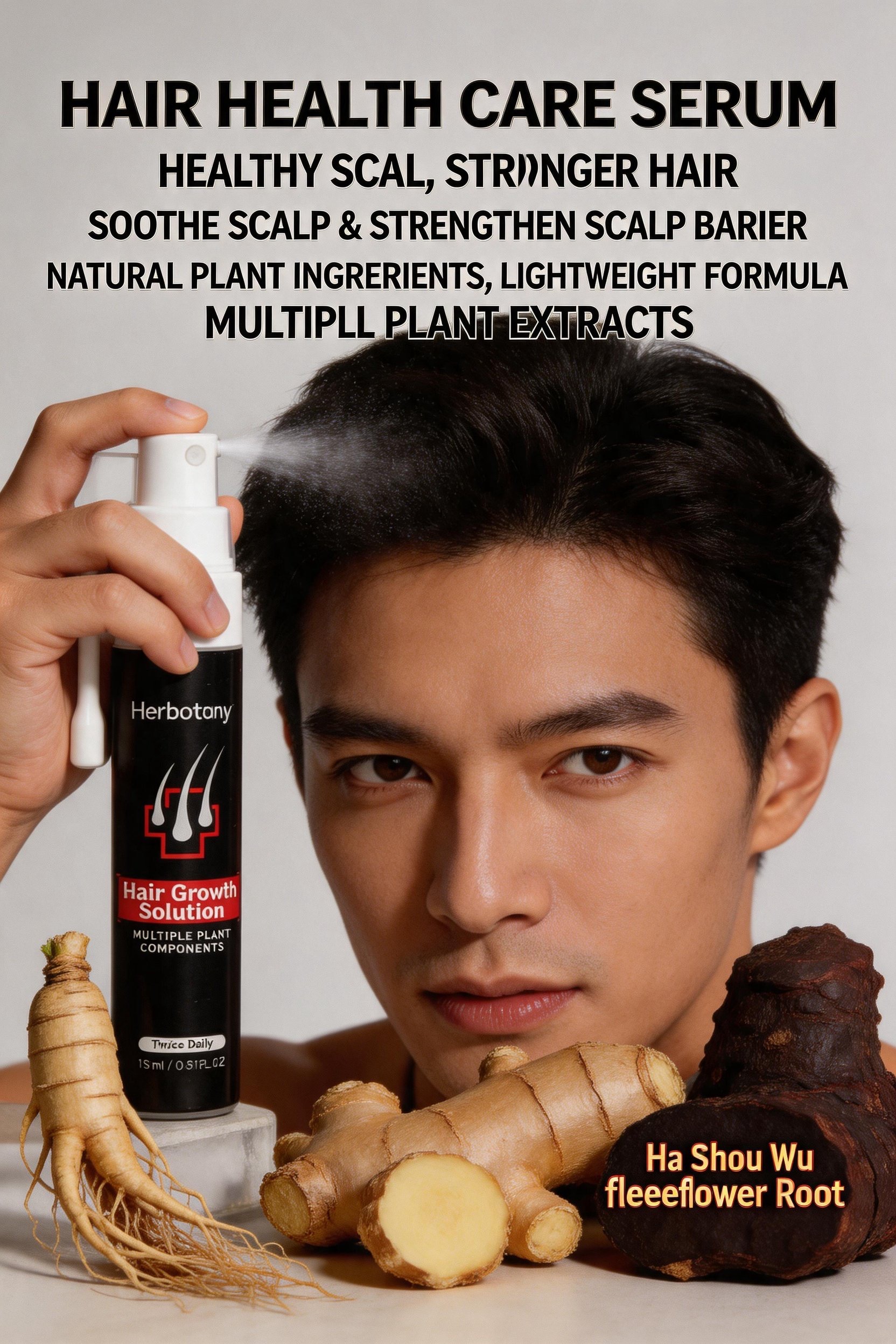
Herbotany’s hair regrowth series is developed precisely on this scientific understanding. By carefully blending core botanicals such as ginseng, Polygonum multiflorum, and ginger, we achieve coordinated effects in several directions:
Activate hair‑growth signalling pathways – Ginsenosides and active compounds from Polygonum multiflorum work together to promote Wnt/β‑catenin, MAPK, PI3K/Akt and other signalling pathways related to hair growth, awakening dormant follicles back into the growth phase.
Modulate androgen effects – Plant‑derived miRNAs and small molecules from Polygonum multiflorum synergistically reduce the adverse influence of DHT (the core hormone in hair loss) and protect susceptible follicle cells.
Enhance local blood flow and microcirculation – Various active components complement each other to improve scalp health and optimise the follicle’s energy supply.
Maximise safety – Our team strictly uses high‑quality plant extract raw materials; all active ingredients are quality‑controlled according to safe topical use standards, avoiding any potential side effects.
Herbotany understands that nature is not a simple stack of ingredients, but a precise symphony of chemistry and biochemistry. We are merely humble students, learning how to truly harness the power of nature.
Conclusion: Start from the Root
I once had a friend who told me she had tried almost every anti‑hair‑loss product on the market, yet still felt so tormented that she wanted to give up. I realised then that the psychological blow of hair loss goes far beyond the surface – it quietly erodes confidence. What needs to be awakened, first and foremost, is the courage to look at oneself anew.
In an era dominated by quick fixes, nature’s wisdom remains remarkably patient. The initial trust, the reverence for nature, the sincerity to keep seeking the truth – these are the values that Herbotany unwaveringly upholds.
We will not promise that your hair will “grow into a long, flowing mane overnight.” But we will say this: hair nourished by ginseng, Polygonum multiflorum, and ginger – like a plant bathed in nature – does not regenerate by miracle. It regenerates by daily care.
Herbotany invites you to give your follicles a chance. Respect the wisdom passed down by nature. Awaken the life force from the root.
When hair begins to grow vigorously again on the scalp, perhaps what truly heals is the heart once scarred by hair loss. 🌱
———————
Disclaimer: This article is based on published scientific research and professional review. It is intended for informational and educational purposes only and does not constitute medical advice. Everyone has a unique health profile and different causes of hair loss. Before starting any new hair care regimen, please consult a qualified physician or dermatologist.